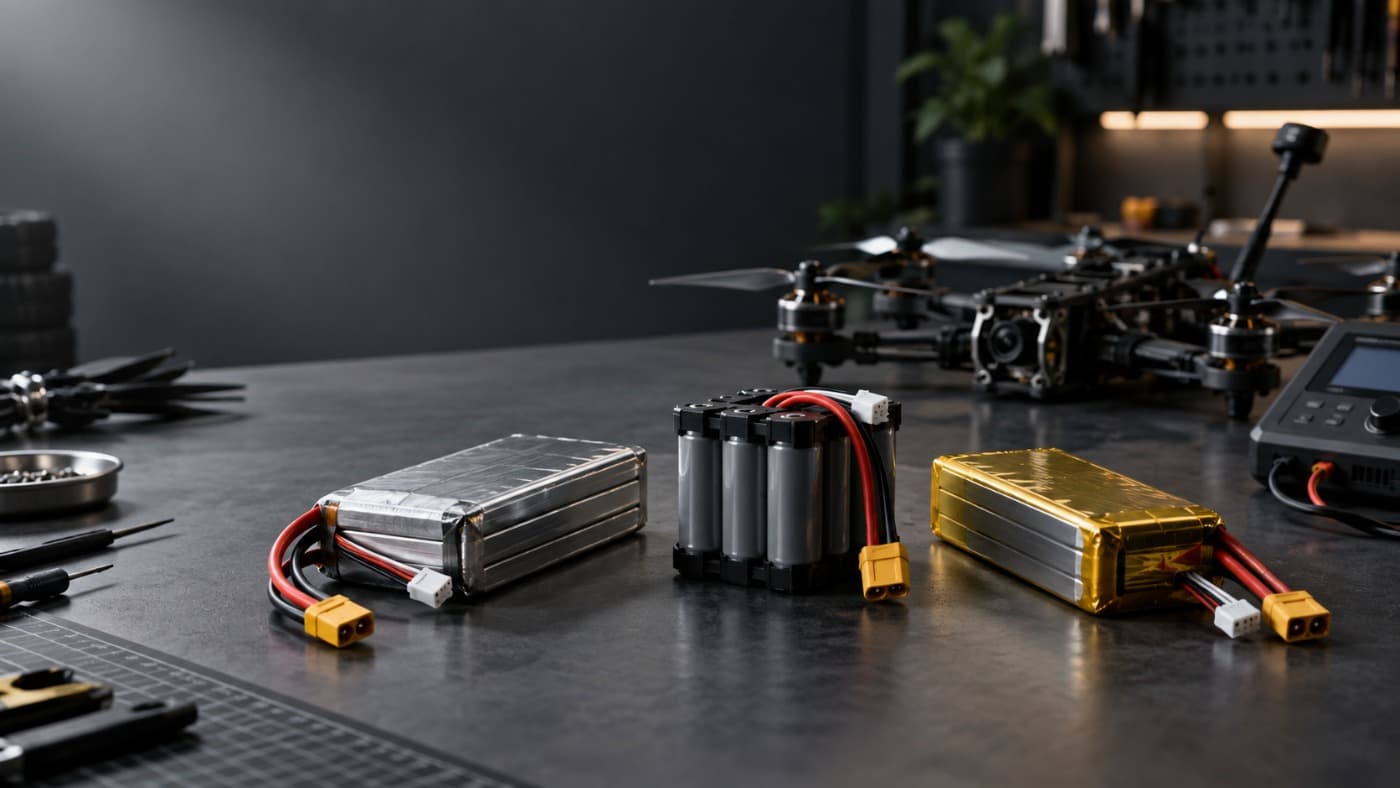
Drone batteries: LiPo, Li-ion, LiHV — and which one your build needs
The battery is the fuel tank, and it decides almost everything else on a drone. Manufacturers tune airframes around it — motor choice, prop size, the whole weight budget — so the pack you pick isn't an accessory, it's the load-bearing decision of the build.
Once you cut through the model numbers and "smart" gimmicks, the hobby drone world runs on two electrochemical families that trade power for endurance, and a few variants that bend the rules. This is the comparison I wish I'd had before the first dead-stick landing.
The three numbers that actually matter
Before comparing chemistries, you need to read a cell the way an engineer does. Three specs filter out 90% of the marketing:
- Watt-hours (Wh) — total energy: voltage × capacity. Flight time is roughly proportional to Wh, everything else equal.
- C-rate — discharge current relative to capacity. A 1300 mAh pack at 100C can theoretically deliver 130 A. The real, honest, continuous number is usually a fraction of the sticker.
- Voltage sag — how much cell voltage collapses under load. Driven by internal resistance (IR), it's the difference between "punch out" and "mushy brick." It's also the one number nobody advertises, because it's the hardest to measure and the most damning.
Everything below is really those three numbers wearing different clothes.
The chemistry cheat sheet
| LiPo | LiHV | Li-ion | LiFePO4 | |
|---|---|---|---|---|
| Nominal voltage / cell | 3.7 V | 3.8 V | 3.6 V | 3.2 V |
| Full charge / cell | 4.20 V | 4.35 V | 4.20 V | 3.65 V |
| Energy density | ~150–200 Wh/kg | ~160–210 Wh/kg | ~240–270 Wh/kg | 90–140 Wh/kg |
| Continuous discharge | 30–120C | 30–100C | 2–15C | 10–25C |
| Cycle life (to ~80%) | 200–500 | 150–250 | 500–1,000+ | 2,000–5,000 |
| Cell form | flat pouch | flat pouch | cylindrical can (18650/21700) | cylindrical can |
| Sag under load | low | low | high at high load | moderate |
| Best for | racing, freestyle | racing | endurance, camera drones | ground stations, safety-critical |
One honesty note up front: energy densities get quoted as cell-level or pack-level, and they're very different numbers. A bare Li-ion 21700 can claim 260 Wh/kg; the finished pack you bolt to the frame (welded nickel, balance leads, heatshrink) lands closer to 200–230. Compare packs to packs and you'll stay out of trouble.
LiPo: the muscle
Lithium-polymer is a pouch cell — electrolyte locked in a gel-polymer matrix inside thin foil. Because the current path from the electrode tab is short and direct, internal resistance stays low (roughly 2–10 mΩ per cell), and that is the whole story of LiPo.
Low IR means the pack holds its voltage when you slam the throttle. A racing quad can punch from 0% to 100% throttle and pull 100+ A through the wires, and the cell barely sags. That's the difference between winning a battery-to-battery drag race and watching your OSD voltage tank. Modern high-C packs from brands like Tattu, CNHL or RDQ are rated 100–150C burst and genuinely hold ~150 A for the few seconds of a race.
The price of that instant power:
- Mediocre energy density — around 140–180 Wh/kg pack-level. You're carrying a lot of foil and tab weight per watt-hour.
- Short life — 200–500 cycles depending on who counts and how hard you fly. Abuse them and this halves.
- Fragility — a punctured pouch fails dramatically, not gracefully. Puffy cells are a write-off.
- Storage discipline — a LiPo left fully charged for weeks loses capacity fast. Storage voltage is ~3.80 V/cell, in a cool, dry place.
Spec sheets also lie in interesting ways. "100C" from a budget brand and "100C" from a proven one are different products — the cheap one sags below 3.5 V/cell under load that the good one shrugs off. C-ratings are marketing until you've measured sag.
Li-ion: the fuel tank
Lithium-ion cylindrical cells — the 18650s and 21700s from your power tool or EV — give up current to hoard energy. A good energy cell stores 240–270 Wh/kg while a premium 6S LiPo pack sits closer to 150–180. That gap, plus a flatter discharge curve, is why endurance builds that swap chemistry roughly double or triple their time in the air.
But it comes with hard limits:
- A current ceiling. The best high-drain 21700 cells (Molicel P42A/P45B) sustain 35–50 A per cell. Demand 80 A from a pack and the voltage collapses below 3.0 V/cell almost instantly — which triggers failsafes, not fun.
- The end-of-charge cliff. Li-ion cells hold voltage well, then drop off a ledge at the end. You can safely land them far lower than LiPo (2.9–3.0 V under load), and INAV/Betaflight sensors must be set accordingly — otherwise the "LAND NOW" alarm screams for the last third of the flight.
- Higher internal resistance (15–40 mΩ/cell) means more sag under punchouts. Cruising at 5–15 A is the job; freestyle is not.
The currently popular cells for FPV, if you're building packs:
| Cell | Format | Capacity | Max continuous | Weight | Best use |
|---|---|---|---|---|---|
| Sony/Murata VTC6 | 18650 | 3000 mAh | 15–20 A | ~45 g | lightweight cruiser |
| Samsung 30Q | 18650 | 3000 mAh | 15 A | ~46 g | budget long-range |
| Molicel P28A | 18650 | 2800 mAh | 25–35 A | ~45 g | high-draw small builds |
| Samsung 40T | 21700 | 4000 mAh | 25–35 A | ~68 g | long-range 7-inch |
| Samsung 50S | 21700 | 5000 mAh | 25 A | ~68 g | maximum endurance |
| Molicel P42A | 21700 | 4200 mAh | 30–45 A | ~67 g | best all-round 21700 |
| Molicel P45B | 21700 | 4500 mAh | 45–50 A | ~68 g | most power available |
Rule of thumb from the long-range community: 21700 cans have largely retired 18650s for FPV because the larger can means more capacity and lower IR per watt-hour — unless your build is sub-250g and every gram is sacred.
LiHV: the racer's cheat code
High-voltage LiPo charges to 4.35 V per cell instead of 4.20, which buys roughly 5–10% more energy out of the same pouch, and a slightly higher pack voltage at any given state of charge — both of which show up as a small but real edge in a race. Racing teams treat it as free performance. The cost is cycle life (150–250 cycles is typical) and stricter charger support; you must charge on the LiHV setting or you damage the cell. Great for a race day, poor for a pack you want to own for two seasons.
What consumer drones actually ship
Here's the part that surprises people: camera drones like DJI's run on energy-optimized lithium-ion, not racing LiPo. DJI's official spec sheet for the Mavic 3 battery lists it as Li-ion 4S — 5000 mAh, 77 Wh, 335 g. Do the division: that's ~230 Wh/kg, comfortably in Li-ion territory and nowhere near a high-C LiPo pack. The Air 2 / Air 2S pack is "three-cell polymer lithium-ion," 41.4 Wh, good for over 30 minutes.
So your "Mavic battery" and a racing battery aren't the same chemical at all. The consumer pack is tuned for steady cruising efficiency and cycle life, wrapped in a smart case with cell balancing, temperature logging and self-discharge to storage voltage. The racer's pack is a bare foil bag tuned for a half-second of 150 A. Same lithium, opposite priorities. Also note: online store listings often mislabel these as "LiPo 4S" — trust the energy density and the spec sheet, not the marketing label.
Same airframe, two batteries, real numbers
The best comparison I've found came from a measured test on an identical 7-inch long-range quad (680 g without battery, same motors and props). The pack is the only variable:
| Pack | Weight | AUW | Hover | Cruise (40% throttle) | Punchout sag |
|---|---|---|---|---|---|
| 6S 1300 mAh LiPo (100C) | 220 g | 900 g | 7 min | 9 min | 0.5 V |
| 6S 2200 mAh LiPo | 350 g | 1030 g | 11 min | 14 min | 0.8 V |
| 6S1P Samsung 50S (5000 mAh li-ion) | 420 g | 1100 g | 21 min | 28 min | 2.1 V |
| 6S1P Molicel P45B (4500 mAh li-ion) | 410 g | 1090 g | 19 min | 25 min | 1.4 V |
Two or three times the flight time from about 200 g of extra pack weight — but look at the sag column. The LiPo gives up half a volt on a punchout; the Samsungs sag over two volts, which under load means a distinctly lazy climb. Different tools, different missions. A 6S 50S pack weighs close to a 1300 mAh 6S LiPo while holding well over three times the capacity — that's why "I fly to the mountain and back" is a Li-ion sentence and "I ripped a power loop off that rock" is a LiPo one.
Whoops, micros and connectors
At the tiny end, power-shy 1S and 2S micro quads (whoops, toothpicks) have their own ecosystem: high-C 1S LiPo cells with HV and non-HV variants, and a connector war that is genuinely consequential. PH2.0 is the old default and a bottleneck for anything punchy; BT2.0 and A30 lower resistance and unlock more punch for a few extra grams; bigger builds step up through XT30 to XT60 as current scales. Connector choice on a 1S whoop can change a flight's character more than the cell itself — cheap connectors are voltage sag you can feel on the stick.
Safety, storage, charging — the boring chapter that saves your workshop
- LiPo and LiHV: store ~3.8 V/cell, charge at 1C by default, charge in a bag or a vented container, and retire any pack that puffs, shows physical damage, or won't balance. Discharge is discharged — never go below ~3.5 V/cell resting.
- Li-ion: more forgiving of full-charge storage and deeper discharge (3.0 V under load is fine), which is one reason commercial fleets love them — simpler logistics, no storage-voltage religion.
- Logistics: anything above ~100 Wh faces airline and courier restrictions; high-energy li-ion packs in particular draw scrutiny whether they're "consumers" or not.
- Cold: all lithium chemistry loses usable capacity in the cold, and LiPo feels it first. Below ~15 °C, warm the pack (or at least the batteries) — a cold pack sags like it's already empty.
Decision table
| Mission | Battery |
|---|---|
| Racing, freestyle, acro, punchy proximity | high-C LiPo (100C+), LiHV for race day |
| Long-range explorer, endurance, mapping | Li-ion 21700 pack (Samsung 50S / Molicel P45B) |
| Camera drone (DJI-style) | whatever shipped with it — li-ion, energy-tuned, smart |
| Cinematic cinewhoop / cruising | lower-C LiPo is plenty, or li-ion for long cruises |
| Sub-250g outdoor explorer | li-ion 18650s where every gram is the budget |
The honest takeaway
There is no best battery — there's the battery that matches the flight. A racer who converts to li-ion loses the one thing that wins races, which is instant current delivery. A mountain surfer who stays on LiPo is flying a sprint where a marathon belongs. The pilots who get the most out of lithium own both and swap packs based on the day's plan: a pair of punchy LiPos for the warm-up ripping, then a li-ion pack for the sunset cruise back home. Know the three numbers — Wh, C, sag — and you'll know the mission long before the vendor does.
Numbers in this post are typical ranges across hobby and consumer packs, grounded in manufacturer and community measurements as of September 2026. Pack-level energy densities, C-rating labels and cycle life all vary heavily by brand, abuse and temperature — verify against your own packs before you trust any of it.
Keep reading
Referenced tools