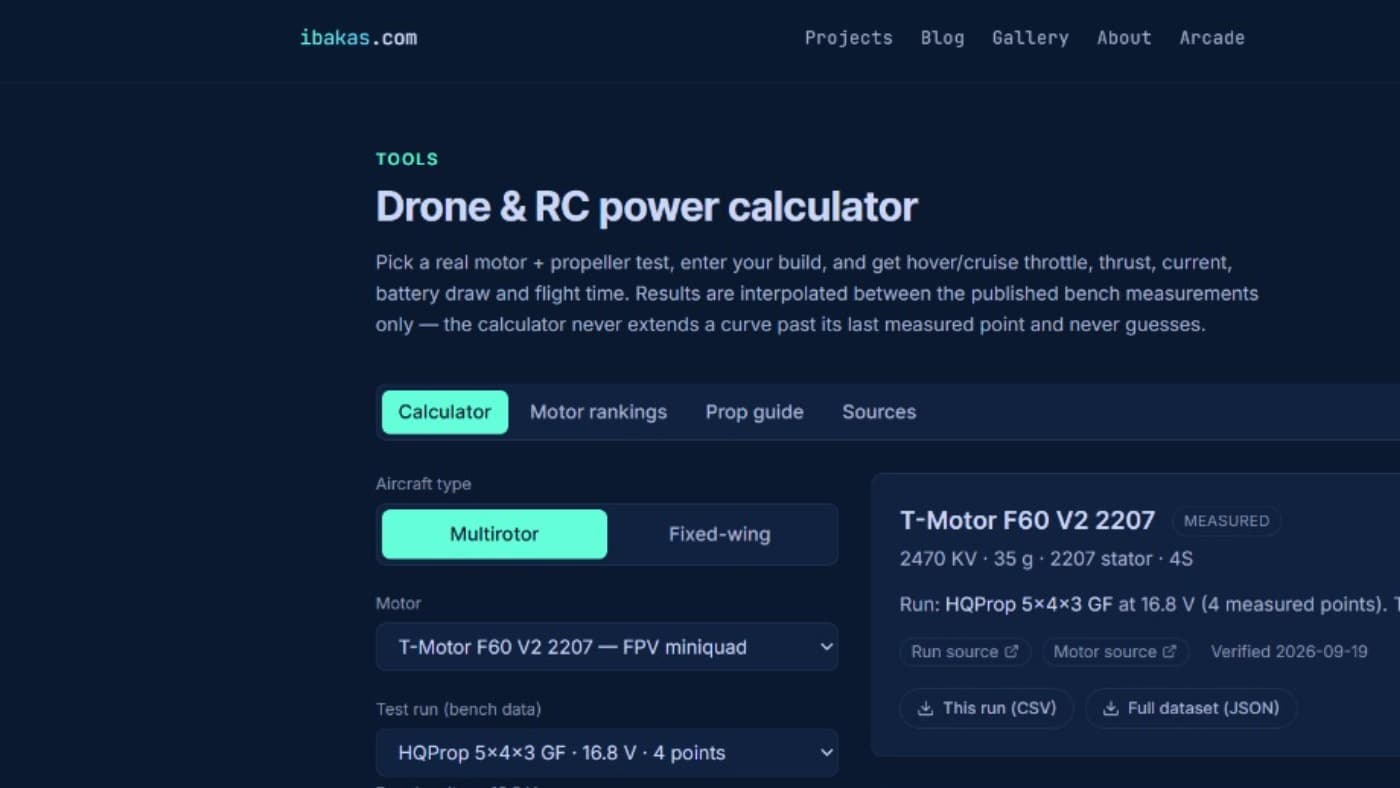
If you've ever picked a motor and prop for a build and just hoped it would fly, this is for you. I've been collecting real thrust test data and it's now live in a calculator on this site: the Motor & Prop Calculator.
And the important part — nothing in it is simulated. No curve fitting, no "should be about…", no manufacturer marketing numbers. Every row is a measured number from a real test stand, transcribed verbatim, with its source and verification date attached.
What the calculator does
Pick a motor, pick a prop, pick a battery — and you get the full picture at each throttle step: thrust, current draw, voltage, rpm, and efficiency in grams per watt. From there you can:
- Find your hover throttle for a given all-up weight (the point where thrust per motor equals AUW ÷ number of motors).
- Compare props side-by-side on one motor, with overlaid curves and a summary table.
- Check the g/W efficiency curve to see where a prop is most economical, not just where it peaks.
- Work backwards from a desired flight time to a battery capacity, using real sustained current numbers.
- Glance at motor rankings — peak thrust, peak current, and efficiency across the whole dataset.
- Pull figures into your own spreadsheet with one click (CSV/JSON export on every chart).
There's also a full motor rankings page, a prop guide with dimensions, and a sources page that lists where every single number was measured.
Where the data comes from
Three sources, all transparent on the sources page:
- Mini Quad Test Bench — most of the five-inch FPV motors. These came off a proper load-cell thrust stand with a custom 4 ms datalogger, an ACS758 current sensor, an eRPM sensor, and a bench power supply, tested with a 40 A ESC at medium-high timing. The 100% values are the sustained averages, not short transient peaks.
- T-Motor official datasheets — the big lift motors (MN5008, MN601-S, V602, AT-series). Those are the manufacturer's own measured tables, transcribed row by row.
- Community submissions — there's a submission form on the calculator page, so this dataset can keep growing.
Every motor row records its source_url and the date it was last verified. If a table printed a nonsense value, I recorded the value that was published and flagged it in the notes rather than silently "fixing" it.
A few numbers I like
| Motor | Prop | Voltage | Thrust (g) | Current (A) | RPM |
|---|---|---|---|---|---|
| iFlight Xing 2306 2450kv | HQProp 5x4x3 | ~15.6 V | 1243 | 31.1 | 31,778 |
| Five33 2207 1950kv | HQ v1s 5x4.5x3 | ~23.7 V | 2021 | 46.5 | 35,134 |
| SunnySky E-R2207 1800kv | Lumenier Buttercutter 5x5x3 | ~23.0 V | 2053 | 46.4 | 33,224 |
| T-Motor F80 2500kv | KingKong 6x4 | ~14.9 V | 1955 | 56.4 | 29,510 |
| T-Motor MN601-S 170kv | T-MOTOR P20x6 | ~47.3 V | 5809 | 20.7 | 6,482 |
That last one is why a 170 KV motor on 20-inch props belongs in a completely different conversation than a 2450 KV freestyle motor.
What it can't tell you
Honesty is part of the point. This is static bench thrust — a prop bolted to a stand with no airspeed. In forward flight, props unload and behave differently, so:
- A prop that tests poorly on the stand can still be brilliant in the air (turbo designs especially). Use the data to compare one prop across motors or one motor across props, not to declare a prop "better".
- Current draw is sustained on a bench supply — real batteries sag under load, so your flight current will start higher and taper.
- There's no thermal soak in these numbers; the long 100% bursts on heavy props are worst-case, run it for real at your own risk.
Treat it as a starting point that's orders of magnitude better than guessing.
Give me more data
The whole thing ships with 33 motors, 51 props, and 238 measured runs, and the bundled dataset means the calculator works even where the database is unreachable. If you have measured data of your own — a motor and prop table from a test stand or a good source with real numbers — use the submission form on the calculator page and I'll review it into the dataset.
Have a look: calculator — and let me know what you'd want next. More motors? More prop sizes? Bigger UAV coverage?